
With elections scheduled in Brazil this year, criminal activity during this period will increase. High-profile data breaches and political secrets are the top cybersecurity trends for 2022.
With only a few months to go before the election, nerves are already frayed. This is when the infamous fake news, disinformation and a fast-spreading cyberwar begin.
Cyberwarfare is a byproduct of technological advances, the same advances that enrich our lives by breaking down borders, spreading knowledge and expanding the opportunities of a freer, more connected world.
And with Brazil's elections approaching, hacker attacks may deepen polarization, sow distrust in services (especially public ones) and create a war of narratives, as happens with fake news on social networks and messaging services (such as WhatsApp and Telegram).
Cyberwar, or cyberwarfare, can be defined as the use of cyber (digital) attacks by one country or nation to disrupt another's computer systems, with the aim of causing significant damage “comparable to actual war,” as P. W. Singer defines it in his book “Cybersecurity and Cyberwar: What Everyone Needs to Know.”
Cyberattacks cause physical and psychological harm to people and objects in the real world and can destabilize a nation as dramatically as, or even more than, a “real” attack, that is, a literal invasion of a country.
If we look at their destructive potential, these attacks are in fact a highly destructive, silent and, in some cases, depending on their severity, irreversible threat.
And it's no different when politics is involved, because, as we have seen before, the outcome can often be disastrous.
The president of Brazil's Superior Electoral Court (TSE), Edson Fachin, said in an interview that cyberwar against the Electoral Justice system “has already been declared,” but stressed that the institutions will act to defend democracy in the country and safeguard the credibility of the elections.
There is a trend toward the political use of cybercrime, since it can be weaponized to undermine trust in public institutions or in the opposition.
Especially because this is an election year in Brazil, there may be information security incidents with direct or indirect political motivations.
These attacks often emerge alongside disinformation campaigns.
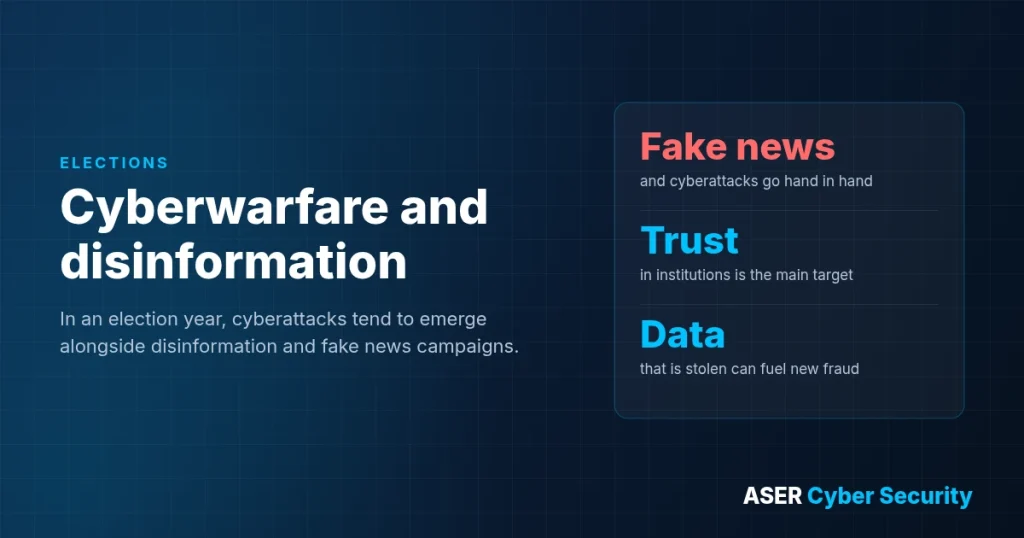
Like disinformation and fake news campaigns, major politically motivated cyberattacks don't affect only technology systems, according to Pano Yannakogeorgos, associate professor at NYU (New York University) and director of the university's master's program in cybersecurity.
“These are crimes that affect the human mind; they try to influence people,” he explains.
“We'll see this more and more. With societies fragmented along socioeconomic lines and more and more people connected to the internet, there will also be more disinformation, only worse, because we have increasingly sophisticated technologies such as deepfakes and artificial intelligence,” he says.
Enjoyed this content? Then read our other articles available on our website.
One point of concern is that, with so many cyberattacks and data thefts, electronic voting machines could be attacked, leading to major consequences.
That's why…
Always stay secure and assess your systems so that fake news and data theft attempts don't cause even greater damage to your company.
???? Is your brand being used in scams? The ASER Cyber Threat Intelligence monitors the internet and the dark web for threats against your company.
Talk to one of our specialists and get a security assessment of your data.
Is your company prepared for this scenario?
For more than 20 years, ASER has protected Brazilian companies with 100% managed security. Talk to an expert and get a free assessment of your business risks.