
Imagine that at 2 a.m., an administrative account shows unusual access activity. The alert comes in. Who investigates? Who can lock the account? And who decides what to do if that account also supports a critical service? The answers define how your SOC, or Security Operations Center, will work.
Design the response before you price the platform
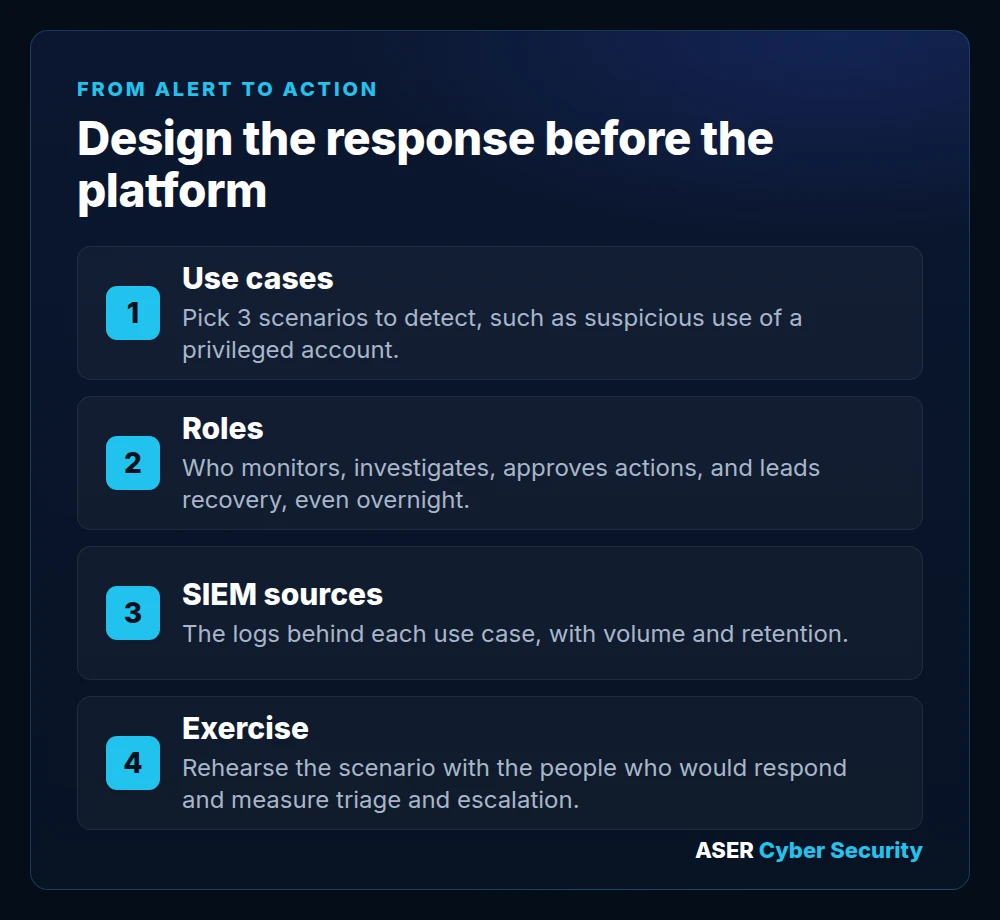
Choose three scenarios the company wants to detect and handle, such as suspicious use of a privileged account, abnormal activity on a critical computer, and a disruption in log forwarding from an important system. For each scenario, specify who monitors, who investigates, who approves actions, and who coordinates recovery. Include after-hours contacts and backups.
In a co-managed operation, spell out which actions the provider can take and which depend on your team. NIST SP 800-61 Rev. 3 treats incident response preparation as part of ongoing risk management.
Prioritize what the SIEM needs to see
A SIEM is the platform that collects and correlates security logs. To price one, start with the sources that support the use cases you chose, such as identity and endpoint protection logs. Identify which logs help detect an event and which are mainly consulted during an investigation. The guidance on priority logs for SIEM ingestion from the Australian Cyber Security Centre (ASD/ACSC) can help structure that choice.
Use a simple spreadsheet listing source, use case, typical and peak volume, required retention, and escalation owner. Measure volumes over a representative period, include peaks, and confirm with the vendor whether pricing is based on volume, number of assets, or another unit. That way, proposals with different scopes won't look equivalent just because they share the same name.
Run an exercise before expanding coverage
Walk through the administrative account scenario with the people who would handle the case. Check whether the team can find the logs it needs, reach the right person, and knows what action it is allowed to take. Record the gaps and track metrics such as time to triage, time to escalation, and availability of critical sources.
Template: SOC and SIEM sizing
| Source | Use case | Typical and peak volume | Retention | Escalation owner |
|---|---|---|---|---|
| Identity (e.g., directory) | Suspicious use of a privileged account | |||
| Endpoint protection | Abnormal activity on a critical computer |
If you already have security tools or partners, start by mapping out that division of responsibilities. It's the starting point for a conversation about ASER SOC without assuming you need to replace what already works. Talk to an expert.