
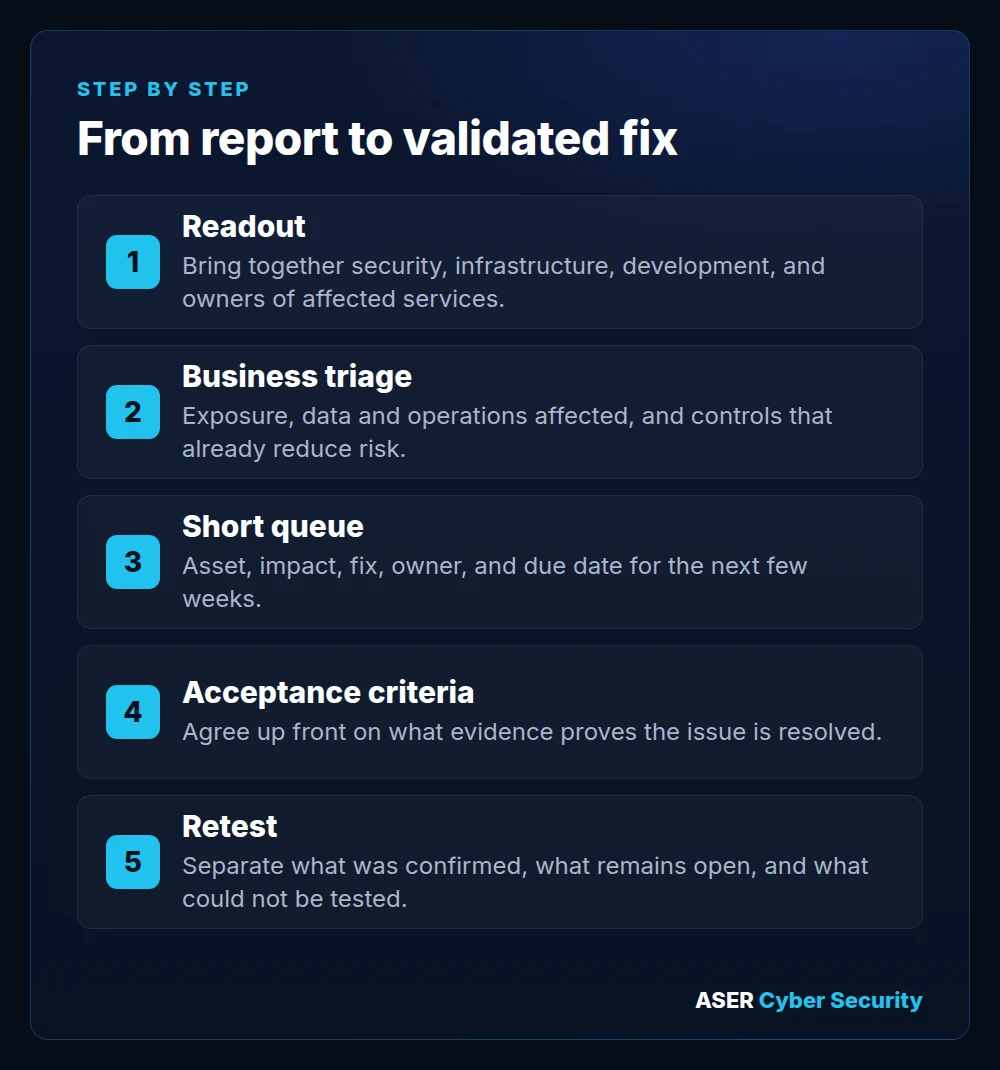
The report landed with dozens of findings. Before you open a ticket for each one or commission another test, figure out which fixes reduce the most risk and which teams can actually carry them out. The best first step is usually a readout meeting with security, infrastructure, development, and the owners of the affected services.
Start with business impact
Use the report's technical severity ratings as a starting point, not as an order of execution. During triage, consider whether the system is internet-facing, what data or operations it supports, and which controls already reduce the risk. A significant issue in the ordering portal may need attention before a technically more severe one that is isolated and has compensating controls. Record the rationale behind each decision so it can be revisited if the environment changes.
In a fictional example, a distributor's customer portal has a finding related to access to order data. The application team takes ownership of the fix; the business owner approves the change window; and security defines up front that the acceptance evidence will be validation, in an authorized environment, that the data is available only to the intended roles.
Give every item an owner and a definition of done
Build a short queue for the next few weeks. For each finding, note the asset, the impact, the immediate mitigation (if any), the planned fix, the owner, and the due date. If fixing it right away would put an essential service at risk, document the temporary measure, who accepted the residual risk, and when it will be reviewed.
Don't close an item just because the change made it to production. Agree on how the fix will be verified and, when a retest is warranted, confirm the scope and the expected evidence. Then record separately:
- what was confirmed as fixed;
- what remained open and why;
- what could not be tested and what is still needed to test it.
The NIST SP 800-115 publication is a good reference for planning tests, analyzing findings, and defining mitigation measures.
Template: remediation queue
| Finding and asset | Impact | Priority | Owner | Deadline | Expected evidence | Status |
|---|---|---|---|---|---|---|
| Fictional portal: access control | Exposure of order data | High | Application team | 15 days | Validation of authorized roles | Pending validation |
If your company already has a report, start there. ASER Security can help you sort out priorities and determine what needs additional validation, without repeating an assessment that is still good enough to support the decision. Explore our Penetration Testing and Vulnerability Management, or talk to an expert.