
Biometric identification is already a reality, but identification through odor and breath could revolutionize everything we know.
Given today's reality of countless technologies and constantly changing information, it may now be easier to understand how a new type of biometrics could be used.
Odor biometrics is based on identifying all the chemical compounds present in a person's breath.
But all of this can bring both benefits and new openings for attacks and data theft.
So keep reading this article to learn more about this new type of biometrics.
Where did breath and odor biometrics come from?
It comes from a group of researchers at several Japanese universities who recently published an interesting study describing a new form of biometric authentication: breath analysis.
The study explains that the idea is similar to the breathalyzer test that ordinary drivers like you and me have taken, and that professional drivers and people in other hazardous occupations take regularly.
However, that is where the similarity ends.
The proposed method is much more complicated than that.
To give you an idea, it has to identify not one but several different chemical compounds in the breath.
In addition, the procedure must not only measure the concentration of certain substances but also tell one person from another by their chemical “breath print.”
So how does breath biometric analysis help?
Overall, breath analysis is considered a cutting-edge field of research.
With the help of machine learning to process data, major advances have been made in this area.
For example, in diagnosing respiratory diseases.
So if analysis systems and learning algorithms are already available, why not explore their potential for authentication?
How does odor-based biometrics work?
In the first phase, exhaled air is collected from each of the test volunteers.
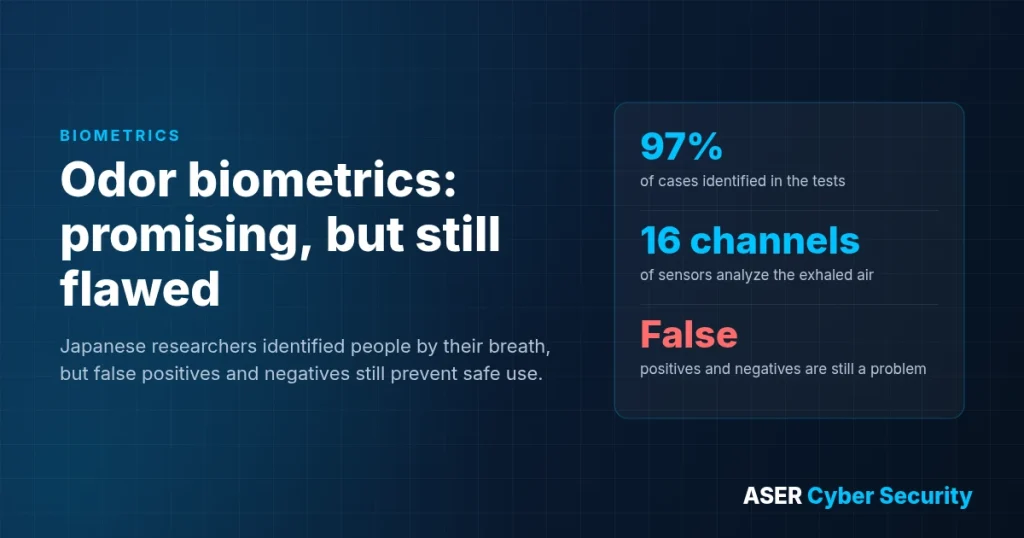
This air then goes through a 16-channel analyzer (the researchers tried collecting data with fewer sensors, but that immediately reduced the method's effectiveness).
Each channel detects a specific chemical compound in the air.
The analyzer records not only the strength of the sensor signals but also how that strength changes over time.
As a result, a wide variety of data is collected and processed with the help of a machine learning algorithm.
After being trained on the test data, the algorithm can identify a person by their breath with considerable accuracy.
Is odor-based biometrics reliable?
According to the Japanese scientists, a person can be identified by their breath in 97% of cases.
In other words, identification was possible in most of their tests, but it still cannot be stated with certainty.
A study conducted in 2016 does not provide enough detailed information on how odor-based authentication performs on this front.
What is this type of biometrics useful for?
In short, there is no practical use for this type of technology yet.
But it is clearly an interesting field of research that could be developed further in the future.
And even if we never get “breathe into this tube to identify yourself” biometrics, we may end up with improved medical diagnostic systems.
What are the benefits and drawbacks of this new biometrics?
A major problem found in most of the tests was the occurrence of false positives and false negatives, which can hinder or skew identification.
False Negative
In the tests, some identification attempts came back negative simply because of a change in the chemical compounds.
In other words, any change, such as an illness or a different meal, can alter the result and prevent you from being identified by the biometric system.
False Positive
The same thing happens as with a false negative, but in reverse.
Other people could be identified simply because the chemical compounds in their breath are similar.
This makes it easier for data and information to be stolen.
Conclusion
This technology, which allows identification through breath and odor, is still being tested.
But for now, there are still barriers to overcome before this system is secure and free of gaps that would let others access your data.
In a way, this is a warning about how secure the systems we use today really are.
???? Every form of authentication needs to be tested. The ASER Penetration Testing checks whether your access controls can withstand real attacks.
With that in mind, I recommend that you find ways to regularly analyze and check the security of your systems with more than just an antivirus.
Talk to one of our specialists and run the tests needed to keep your data and your company secure.
Are your company's access controls secure?
For more than 20 years, ASER has protected Brazilian companies with 100% managed security. Talk to an expert and get a free assessment of your business risks.