
Scammers are robbing cryptocurrency users with a fake Nvidia giveaway worth 50,000 BTC.
Cybercriminals keep using the names of famous people and companies to deceive cryptocurrency users.
This time, they exploited the Nvidia brand, a developer of GPUs (graphics processing units) that are popular among cryptocurrency enthusiasts.
After all, many cryptocurrency mining rigs have been built on its GPUs.
Next year Nvidia turns 30, and like any other company, it celebrates milestone anniversaries.
The scammers took advantage of exactly that by setting up fake cryptocurrency giveaways.
How did the scam work?
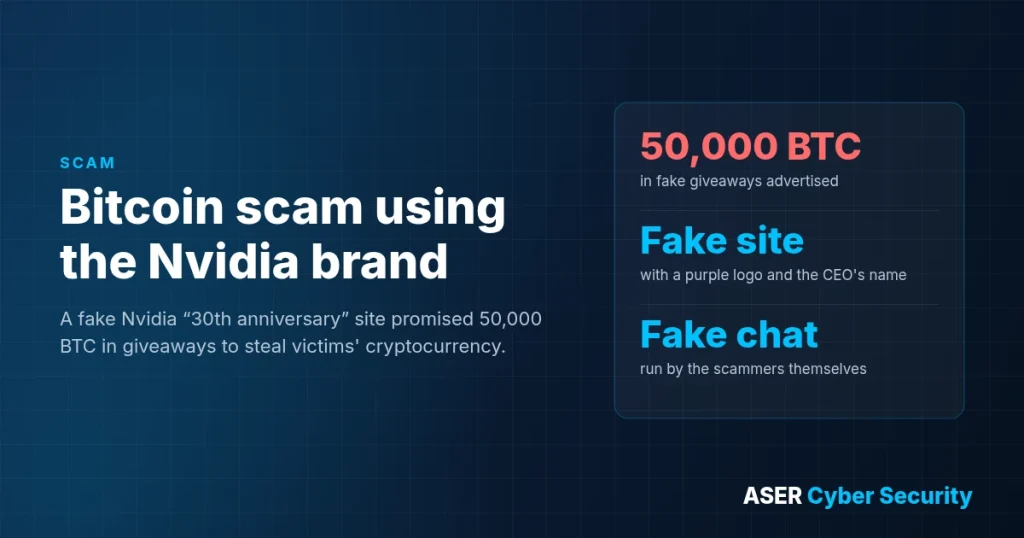
The scammers created a fake website supposedly dedicated to Nvidia's 30th anniversary and announced a large bitcoin giveaway there.
On the fake site's home page, visitors see the company's logo (a purple emblem instead of the usual green one) and the name of its CEO, Jensen Huang.
There, visitors are invited to choose a category to join an event that, in reality, offers nothing.
There is just one big button that reads “Bitcoin Giveaways.”
After clicking the button, the user is taken to a page with detailed information about the giveaway.
At first glance, the page looks convincing: there is a photo of the CEO and additional menu sections, all well designed to pull off the scam.
But instead of the Nvidia logo, there is a Bitcoin icon, plus several grammatical errors in the text, something a serious company would never let slip.
At this point, the cybercriminals announce a giveaway of 50,000 BTC (worth more than R$ 5 billion at the time of writing).
As a condition for entering this giveaway, the user must make a contribution to get in, like buying a lottery ticket.
As part of the scam, they promise that participants will immediately receive double their money back, not to mention the prospect of winning the 50,000 BTC.
Participants are given a crypto wallet address to transfer funds to, along with instructions.
At the bottom of the page, there is a live feed of the “winnings” paid out by the organizers.
To reinforce the impression of a legitimate website, the scammers created a fake Nvidia support chat.
The people answering this chat are the scammers themselves.
If you enter the scammers' crypto wallet address on Blockchain.com, you can see that some money was in fact transferred to it, a total of 0.42 BTC (worth around R$ 52,000 at the time of writing).
We don't know for sure who sent these funds: they could be victims or the scammers themselves.
Either way, there is no trace of the advertised 50,000 BTC and no sign of anyone getting double their money back.
How to protect yourself from these scams?
We understand how hard it can be to resist a tempting opportunity like this, but to avoid unpleasant situations, we recommend following a few simple security rules.
Be skeptical of information
Don't blindly trust information just because it seems to come from a celebrity or a well-known brand.
Always verify information against secondary sources on official websites.
Avoid clicking on just any link
Don't click on every link that shows up, especially links from unknown sources, such as those in emails.
It's better to look up important information on your own using search engines.
Always check websites to avoid virus infections and data theft.
Don't jump at offers that seem too good to be true
If you see a promise of gains or anything that seems too extreme, be suspicious.
After all, if you don't stay calm, you run a high risk of being robbed or deceived.
So keep calm and be cautious when someone asks you to take urgent action, or you will lose money.
Learn to spot scammers
It may sound strange, but you need to be able to tell when something is a scam and when it isn't.
There are signs you can recognize that show you are being targeted by a scam.
Look for reliable security solutions
It is extremely important to have a security solution that helps you keep your systems secure.
Whether through antivirus, endpoint protection or any other security measure.
Choose a company you can trust and protect yourself from online scams.
???? Your brand could be used in scams like this one. The ASER EASM monitors fake domains and exposed assets linked to your company.
Conclusion
In short, it is very easy to fall for cybercriminals' scams if we don't pay attention and look into the subject.
Most of the time, that doesn't happen, whether by mistake, out of a desire to win something, or even because we trust that big brand or well-known person.
If you have ever fallen for a similar scam, you now know what to do and how to act from now on.
But your first step should be to find a security company you can truly trust.
We provide the best solutions to secure your systems.
Just talk to one of our experts and get a free consultation.
Are your brand and your data protected?
For more than 20 years, ASER has protected Brazilian companies with 100% managed security. Talk to an expert and get a free assessment of your business risks.