
Facial recognition is a tool that has made life easier for many people thanks to the convenience and security it brings, since only the user's own face is accepted.
We recently learned that cybercriminals have found ways to bypass this system and run scams using images of certain people.
In 2021, an advertising professional living in São Paulo fell victim to a facial recognition scam.
When Piero Rossi showed a photo of himself to confirm receipt of a delivery, he fell victim to a scam that left him with debt from financing a 2018/2019 Volkswagen Amarok V6 pickup worth roughly R$ 200,000.
The scammer got hold of the image and used it to obtain financing through Brazil's Itaú bank.
No one knows where the vehicle ended up, and the case remains unsolved.
This was not the only incident involving this type of fraud.
A notable case occurred in China, where a group of fraudsters managed to fool facial recognition and access the national invoicing system under other people's names, causing losses of US$ 76 million.
The group used techniques such as deepfakes, which involve creating fake videos by manipulating sounds, images and movements with artificial intelligence, to impersonate other people and gain access to the system.
How Does the Facial Recognition Scam Work?
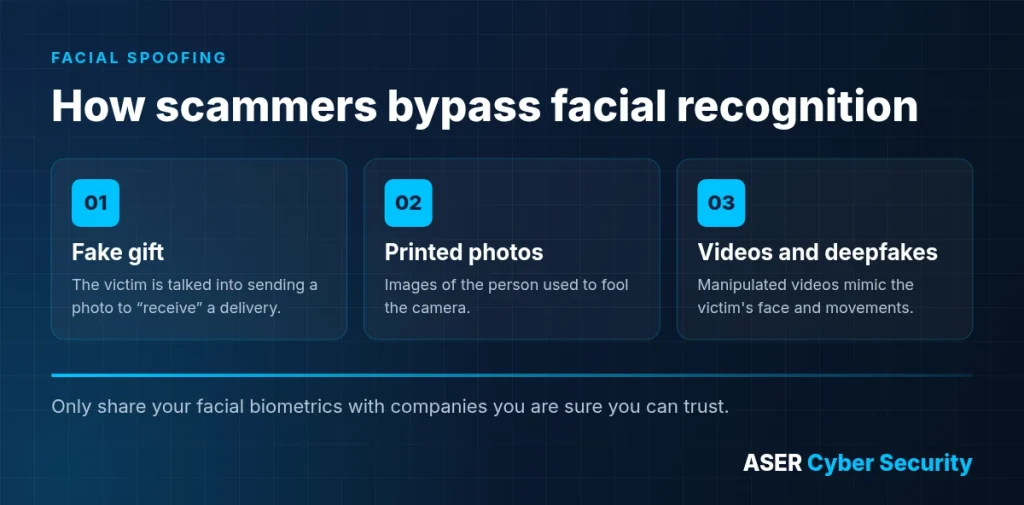
The facial recognition scam even has a name of its own, facial spoofing, which simply means faking someone's face.
It happens when a scammer tries to pass themselves off as someone else to access confidential information for gain, such as financial gain.
Here's how the facial recognition scam works:
- You are contacted by a supposed company claiming there is a “gift” in your name;
- The company may reach out by phone, social media or WhatsApp, for example;
- During the contact, they ask for your address and some of your personal details so you can receive the item;
- Once you provide your address, a “representative” from the front company comes to meet you;
- Then the employee claims they can only hand over the item once facial recognition is completed;
- If you agree, you may fall for the scam;
Because of this scam, companies changed the way they perform facial recognition, asking users to complete steps that confirm the person is actually present at that moment.
The fraud methods scammers use most include printed photos of the person, videos and even 3D masks.
With this access, scammers can steal data, causing losses for companies, which may accept users with fake documents, and creating problems for the real identity owners, who suffer financial losses.
How to Avoid the Facial Recognition Scam
The simplest way to avoid this kind of scam is to not provide your facial biometrics to just anyone; after all, it is extremely sensitive data that opens the door to every kind of scam.
If you have to provide facial biometrics, make sure you are dealing with a trustworthy company and do it on the company's own premises.
Always handle your data with great care and use multiple layers of security to reduce the chances of fraud and scams.
You can keep your data and your company secure by taking precautions and assessing your systems.
???? Does your app use facial biometrics? The ASER's Mobile Pentest tests whether your app's authentication can withstand fraud.
Count on Aser Security to help you improve your information security.
Talk to one of our specialists.
Can your systems' authentication withstand fraud?
For more than 20 years, ASER has protected Brazilian companies with 100% managed security. Talk to an expert and get a free assessment of your business risks.