
Most data breaches come from cyberattacks, mainly phishing, smishing and Business Email Compromise (BEC) schemes.
Company information and data are extremely important. After all, a business is responsible for a great deal, and third parties may be involved as well.
In the first quarter of 2022, 91,200 cases of information and data leaks were recorded in Brazil, a 12% increase compared to the end of the previous year.
These figures make it clear that, regardless of your company's size, you need to take steps to prevent attacks and data breaches.
What is driving the rise in data breaches?
One of the main causes of data breaches was ransomware attacks, which rose sharply with the campaigns of the BlackCat group and caused problems for many companies.
The main explanation for these attacks is the lack of adequate protection for databases, which was largely responsible for the exposures in the region.
A lack of employee training can also be a factor that causes significant losses.
Tactics such as phishing, smishing, spear-phishing and many others are used to gain access to employee and company information.
Practices to prevent data breaches
According to the National Institute of Standards and Technology (NIST), an effective incident response strategy must provide “instructions and procedures so that a company can identify, respond to and reduce the impacts of a cyber incident.”
According to the institute, the incident response lifecycle consists of four basic phases:
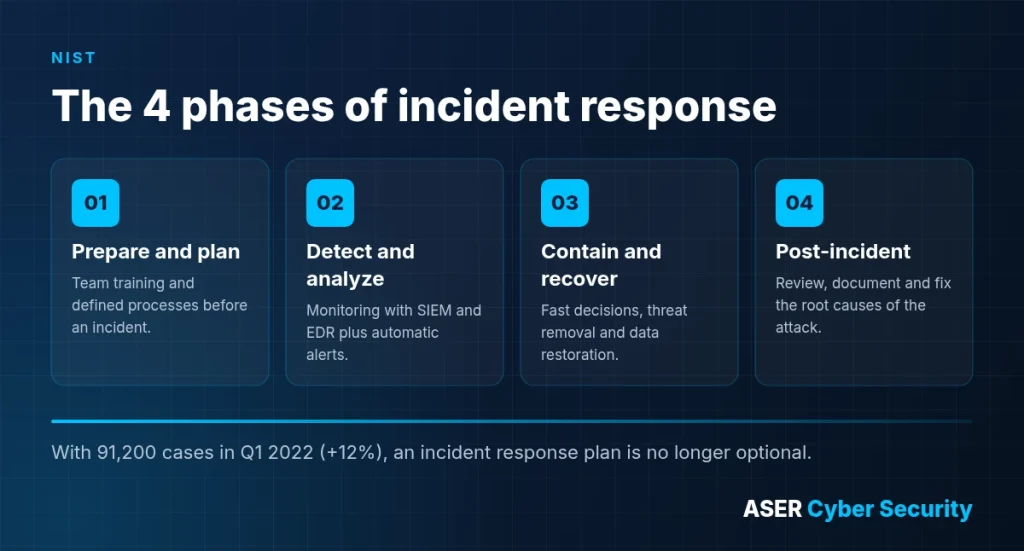
Prepare and Plan
Preparation means getting your employees ready and training them on the importance of data security, so they can quickly identify potential incidents at the first signs of abnormal activity.
In this step, you can also create processes and procedures to avoid business disruptions.
Detect and Analyze
To stop any kind of data breach, you need fast detection and the ability to identify abnormal behavior.
At this point, tools such as SIEM and EDR make it possible to monitor systems and data and to send alerts automatically when a breach is detected.
The best approach is to adopt protection and analysis measures for your companies and services.
????️ Detecting fast is the most critical phase. The ASER SOC monitors your environment 24×7 with SIEM and EDR and responds to incidents for you.
Contain, eradicate and recover
At this stage, it is important to make decisions quickly so that action can be taken as fast as possible once the data breach is identified.
This is how threats are eradicated and the vulnerabilities that affected the systems are eliminated.
Data recovery relies on backups, system rebuilds or even the replacement of compromised files.
Post-incident
If you think everything is solved once the system has been recovered, you are quite mistaken.
After the process is complete, you need to review and document the incident, analyze its causes and list the difficulties and lessons learned so that future responses are more efficient and effective.
These are the recommendations to help you avoid falling for scams and keep your customers' data safe.
Always have a security company helping you analyze your systems and vulnerabilities, so you can prevent any kind of attack.
At Aser Security, we offer a complete system to help you become more secure.
Talk to one of our specialists.
Does your company have an incident response plan?
For more than 20 years, ASER has protected Brazilian companies with 100% managed security. Talk to an expert and get a free assessment of your business risks.