

Vehicles use technologies such as Bluetooth and Wi-Fi to communicate, and in doing so they also open the door to a range of vulnerabilities and hacker threats in the lives of executives at large companies (e.g., CEOs)
You could be at risk… Because they even want to hack into your car.
As vehicles become increasingly “modernized,” with Bluetooth, Wi-Fi and more, a rise in hacker attacks through these features is already a reality.
Cars keep advancing in their use of technology, which could lead to even more attacks in the future. We consumers love these features, but unfortunately hackers love them even more for how easy they make intrusion.
This keeps many people in the automotive industry up at night, as they want to stay one step (or two or three) ahead of those who could end up wreaking havoc on the world's private transportation system.
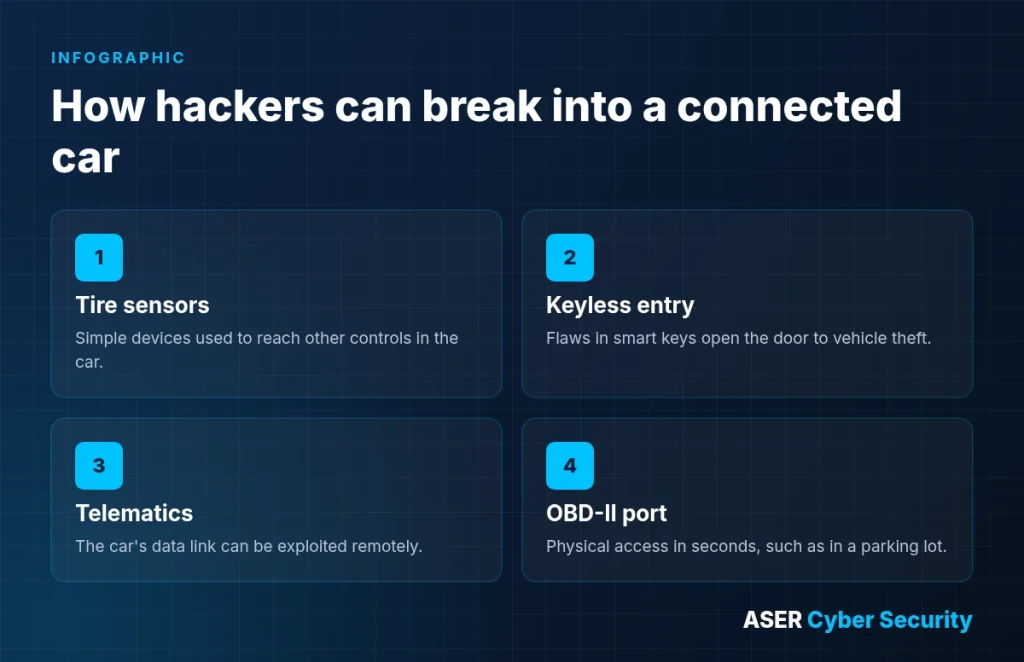
Some of these threats come from:
Simple devices, such as tire pressure monitors, which can be used to access sensitive car controls like the ignition;
Security flaws in keyless technology can open loopholes for car theft;
Telematics allows the car to send and receive data via telecommunication devices.
A hacker can also access the telematics network through external devices (such as the rearview camera) and, through that access, look for security gaps to reach other, more sensitive networks in the car.
An interesting case in point happened in 2019.
Automotive cybersecurity company Karamba Security put a fake vehicle electronic control unit online. And guess what? In less than three days, hackers made 25,000 intrusion attempts, and one of them succeeded.
That is why automotive security is an interesting and complex problem that professionals in this field have yet to solve.
One of the challenges of automotive security is the complexity of organizing the entire production chain, and long model development cycles hinder one of the core activities of information security: updating. Today's car is practically a computer that is online, just like a smartphone or laptop.
That is why it is essential for automakers to identify software vulnerabilities in features such as Bluetooth, Wi-Fi and cellular connections, since they all offer very likely points of attack for hackers.
All of this only confirms that, as much as we expect manufacturers to deliver a fully secure vehicle, cybersecurity experience shows us that this is not something that can be 100% guaranteed forever.
Just as we do everything we can to protect our laptops and smartphones, we will also need to think about adopting a more practical way to make sure our cars are protected against these cyberattacks.
After all, who wants to leave their car vulnerable to hacker attacks?
Nobody wants that.
According to U.S. Navy veteran and digital security expert Andrew Bindner, “The car doesn't even need internet access.
All the attacker needs is access to the OBD-II port (used for electronic diagnostics and repairs) to make a series of modifications to the car.”
This can also happen when you leave your vehicle in a parking lot, for example. In just a few seconds, a criminal can plug a device into the connector, which is usually located near the driver's seat.
Because the OBD-II port is usually hidden behind a plastic cover, the chance of the owner discovering that the car is being tracked and hacked is almost zero. One way to reduce the risk would be to adopt the concept used in modern aircraft.
Although aircraft such as the Boeing 777 have almost all of their controls run by electronic systems, there is a physical and electronic separation between flight-critical software and simpler systems, such as passenger entertainment.
So hackers who claim to have broken into the entertainment system pose no danger to the aircraft, because those programs only read the flight data without changing it.
So How Can You Protect Yourself?
- Remove the pairing of every phone except the ones that are used regularly in the car;
- Disable access permissions for apps and infotainment system features you don't use;
- Don't save your home address in the car's GPS. Use a nearby address instead;
- Keep your smart key in your front pocket (a back pocket makes it easier for attackers to get close enough to capture the device's communication frequency);
If you're somewhere unfamiliar, lock the car the old-fashioned way, using the key in the lock cylinder.
Focus on finding ways to assess your car's weaknesses.
???? Everything that's connected needs to be tested. The ASER Penetration Testing simulates real attacks to find gaps before criminals do.
This prevents the key fob's signal from being captured or jammed.
Book a free consultation so you don't take any chances.
Did you already know about this? Share this content with others.
Are your connected devices secure?
For more than 20 years, ASER has protected Brazilian companies with 100% managed security. Talk to an expert and get a free assessment of your business risks.