
AI has been key to building automated security systems, natural language processing, facial recognition and automatic threat detection
Artificial intelligence (AI) enables machines to learn from experience, adjust to new data inputs and perform tasks the way we humans do.
Machines can make decisions based on data and logical reasoning.
Most of the examples we hear about today, from chess-playing computers to self-driving cars, rely on deep learning and natural language processing.
With these technologies, computers can be trained to accomplish specific tasks by processing large amounts of data and recognizing patterns in it.
But…
What Is the History of Artificial Intelligence?
The term artificial intelligence was coined in 1956, but it has only become popular recently thanks to growing volumes of available data, advanced algorithms and improvements in computing power and storage.
Early AI research in the 1950s explored topics such as problem solving and symbolic methods.
In the 1960s, the U.S. Department of Defense took an interest in this type of technology and began training computers to mimic basic human reasoning.
This early work paved the way for the automation and formal reasoning we see in today's computers, including decision support systems and intelligent search systems that can be designed to complement and augment human capabilities.
How Is It Being Used Today?
Every industry has a high demand for AI capabilities, especially question-answering systems that can be used for legal assistance, patent searches, risk notifications and medical research.
Here are some other uses:
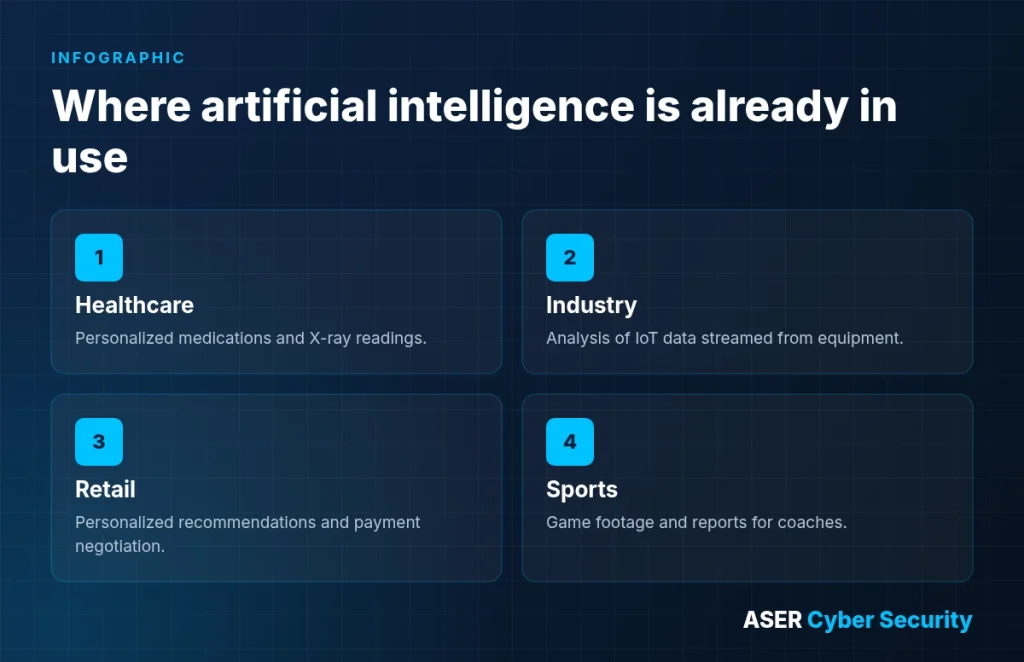
Healthcare Providers
AI applications can deliver personalized medications and X-ray readings. Personal assistants can act as coaches, for example by reminding you to take your medication, exercise or eat healthy foods. Manufacturing
AI can analyze Internet of Things (IoT) data from factories as it streams from connected equipment to forecast loads and demand using recurrent networks, a specific type of deep learning network applied to sequential data.
Retail
It provides capabilities for online retailers, such as offering personalized recommendations and negotiating payments with consumers. Inventory management and website layout technologies are also improved by it.
Sports
Artificial intelligence is used to capture game footage and provide coaches with reports on how to better organize play, including optimizing field positions and strategies. Its goal, therefore, is to provide software that can “reason” about inputs and explain its outputs.
Artificial intelligence provides near-human interactions with software and offers decision support for the tasks at hand, but it is not a replacement for human beings, and it won't be for many years to come.
And How Does Artificial Intelligence Work?
It works by combining large amounts of data with fast, iterative processing and intelligent algorithms, allowing the software to learn automatically from patterns or features in the data.
Artificial intelligence is a very broad field of study that encompasses many theories, methods and technologies, as well as these subfields:
- Machine learning: automates analytical model building. It uses methods from neural networks, statistics, operations research and physics to find hidden insights in data without being explicitly programmed where to look or what to conclude.
- Neural network: a type of machine learning made up of interconnected units (like neurons) that process information by responding to external inputs and relaying it between units. The process requires multiple passes over the data to find connections and derive meaning from undefined data.
- Deep learning: uses large neural networks with many layers of processing units, taking advantage of advances in computing power and improved training techniques to learn complex patterns in large amounts of data. Common applications include image and speech recognition.
- Cognitive computing: a subfield of AI that strives for natural, human-like interaction with machines. The ultimate goal of cognitive computing is for the machine to simulate human processes through the ability to interpret images and speech.
- Computer vision: relies on pattern recognition and deep learning to understand what is in an image or video. When machines can process, analyze and understand images, they can capture images or video in real time and interpret their surroundings.
The potential of artificial intelligence is enormous, and we need to know how to make the best use of it.
We just can't forget to keep up regular system assessments so we stay free of flaws.
???? AI protects your network, too. The ASER NDR analyzes traffic to detect anomalous behavior and threats in real time.
Want to put cutting-edge technology to work for your security?
For more than 20 years, ASER has protected Brazilian companies with 100% managed security. Talk to an expert and get a free assessment of your business risks.